
I realized after my latest hospital adventure I’ve never fully discussed the POTS aspect of what goes on with me. Part of that is it appeared to be manageable on it’s own until last November and the other part was it was consistent, until recently.
Back in November of 2020 a few things changed. We upped my daily IV fluids to 2L instead of 1-1.5 a day. Partially to accommodate my new IV Benadryl but also because I had just been to Augusta’s motility clinic and started on prescription laxatives for my chronic constipation on top of vomiting up all my fluids. So liquids just weren’t leaving my stomach and going anywhere (gastroparesis is great…it makes absolutely zero sense) which meant that maybe my blood pressure was in the tank all the time due to dehydration. We added more fluids and POP, up it suddenly goes. Well past where it should be. Joy, Hypertension at 26…
The Cardiologist we saw in January of 2020 is a POTS specialist and fortunately didn’t make me try and stand to get a blood pressure reading, my number were bad enough just laying to sitting up and my fainting confirmed it. So onto beta blockers I was thrown on top of some rescue meds for when the POTS got really bad.
Here’s the thing about beta blockers, calcium channel ones too, depending on WHY you need them, they can impact you differently. if you take them for anxiety, it’s usually a higher dose to keep the chronic high heart rate down. if you take to avoid or prevent a heart attack, it’s to reduce the load on the heart. In my case it was supposed to both bring down my blood pressure into a manageable range (130/90 is fine with a heart rate in the 80s 150/100 heart rate in 120s is NOT). I’m on a baby dose by comparison and so far it’s worked great on my heart rate, usually. Almost too well. my blood pressure can be fantastic after I’ve slept, but feed me and keep me awake for a while and BAM danger land again.
With POTS, there are a few sub-types and we always thought I fell into the neuropathic (nerve signals aren’t getting back to the brain properly)or secondary (underlying issue is triggering this) versions. But now I’m not so sure. The POTS attacks started to strike in march.
Now it’s starting to look like HyperPOTS aka hyperandregnic. Which means possibly more tests or I could just have a mixed type… Short version? My adrenaline is now causing more problems and kicks in whenever it feels like it. Need to poo? It’ll strike. Sneeze too hard? Here it comes again. I can’t breath or swallow properly. My heart bangs around up and down in heart rate levels, and i can physically feel my blood pressure spike. I can go numb, pale, shaking, sweating, i get pain in my shoulders and neck to the point I can barely move. Then the nausea hits, waves of it combined with dizzy spells and cramps. I faint non-stop when it gets really bad. And then the heart rate is everywhere: dropping into the 70s as I faint before spiking into the 110s and above. That’s pure pain. I can’t describe it other than maybe a mild heart attack, stroke, and seizure all rolled into one.
Except you’re not. Your EKG looks fine, your blood pressure is up and so is your heart rate but that could just be anxiety right? That’s the problem. To the naked eye it looks like an anxiety attack or drug withdrawal. It’s neither. The physical symptoms start before anything psychological and you spend the entire hellish adventure talking yourself down and reminding yourself you ARE NOT dying, having an allergic reaction, choking. You can breath and talk and move so it’s not a stroke. And while my words can turn into pure gibberish, it’s not a stroke.
How do you live with it? How do you explain to someone whose never had this or someone who is only looking at you from a medical perspective and can’t see anything wrong? That you just need time, someone to sit with you and monitor everything, and sometimes an anti-anxiety medicine. Why anti-anxiety? Well they actually are chemically similar to beta blockers and other medications to calm things down in the sympathetic nervous system. Because at the root, that is what a POTS attack is. A massive surge in your sympathetic nervous system behavior followed by a supression in the parasympathetic. This activates the vagus nerve making you nauseated (why sprinters running long distance suddenly can vomit) to try and elicit a response from the body. Your blood pressure rises to circulate more oxygen faster and your heart pumps harder and faster just to keep up.
Now sure we can sit here and compare notes about how an anxiety into a panic attack can do the same thing physiologically. Absolutely that’s true. However, the distinctive difference between an anxiety into a panic attack, is it starts as an anxiety attack and it slowly escalates (and slow can be a few minutes to seconds depending on the person). There is usually a root trigger and if you’ve been through at least a billion hours of therapy you can often utilize those tactics to calm and even stop the attack.. But this? A whole other level. You don’t see it coming. The physiological symptoms start first before you even know it and then suddenly, I DON’T FEEL RIGHT slams into you. Now the mental panic can start. Now the game of “can I calm this down on my own or do I need help” begins.
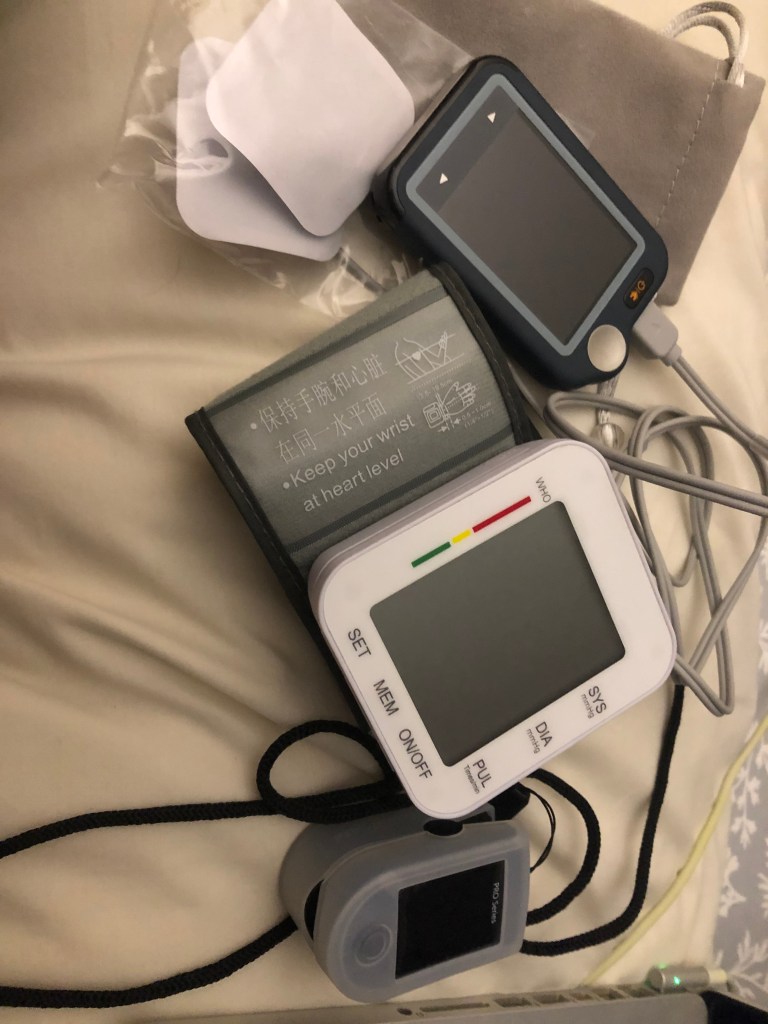
I jokingly call all this my “sanity monitors”. Why? Well the Pulse OX shows me my heart rate [even the bouncing painful ones] and that i am in fact getting oxygen to my numb extremities. It also gives us a bit of a warning if I’m having a “puke and POTS” adventure if I am about to faint. That heart rate drops and BAM I am out. It jumps back up, I’m back. The blood pressure cuff? Well when you feel like you just got kicked in the chest by an elephant who then sat on you, it’s nice to know your blood pressure did actually spike and be able to retake every 10 min until it comes down. It’s not fun to see the numbers keep climbing while you’re laying down and trying to breath for 20 minutes but at least it alerts me if I am going to need the oral Valium to shut it down. That last thing? My latest gadget, a cardiac monitor. Despite being allergic to the sticky pads [talk about itchy blisters] it can take a record a cardiac rhythm for me and save it. The reassurance I’ve not suddenly developed an arrhythmia [amid it feeling like my heart is skipping beats] and that YES IT IS REAL.
This might seem like overkill or pure paranoia but actually, it’s helpful for me. When you feel this bad constantly, so bad that going to the bathroom is an actual nightmare of problems, the consistency available and records can really help bring down that natural level of anxiety that already exists. I’m irrationally terrified of hospitals. They flat out scare me because I can present fine or actually in the middle of a disaster and no one will do anything. It’s like I’ve got the plague and no one wants to touch that mess. Sometimes what I need on top of testing etc, is a nurse to just sit with you. Tell me I am okay and my stats look good. Unfortunately, moms been assigned that job and, as you’ll later hear regarding the hospital saga, had to basically be the medical decision maker, nurse, tech, assistant, advocate, get-zero-sleep-in-this-god-awful-chair person, and babysitter.
When the POTS attack, it can be as sudden as someone dropping an actually pot or as long winded and terrifying as staring into a literal pot waiting for water to boil. It’s sudden and terrifying. More terrifying than when I go loopy because at least I am unaware. Nope, these I am all too aware off on top of not being able to fully communicate what I want or need, sprinkled with extra sudden waves of absolute terror. Vomiting constantly? i can handle. Nausea every waking minute? sure no problem. constant never ending pain? Big deal, whatever. But this is next level. It’s every warning sign we’ve been told is dangerous only to find out in my case it may or may not be. Hospital or no hospital? Will they even understand?
As Dr. Sanjay Gupta of the UK cardiologist and heart specialist consult so brilliantly has said: “
Medical care for patients who have a diagnosis of POTS remains hugely unsatisfactory.
POTS or rather dysautonomia is a very heterogenous condition. No two people are exactly the same. There is no one single aetiology that can even sometimes be identified. Often the patient who is really suffering looks alright from the outside. Many doctors, largely out of ignorance or perhaps arrogance, don’t even believe in the condition. Many don’t know enough about it to start treatment.” https://drsanjayguptacardiologist.com/blog/mestinon-a-glimmer-of-hope-for-pots-patients/
His entire website is fantastic and informative from a MEDICAL perspective. I love my Cardiologist here in Atlanta, but despite being known and sought after for his extensive POTS understanding and research, it’s like every other doctor didn’t bother to read his memo about POTS.
And maybe that’s where this breakdown is occurring. POTS attacks are a hybrid of both a medical emergency and a psychological one. It requires an aspect of both nursing, the support and care and staying with a patient, and doctors, evaluating what medicine or intervention may be needed. Yet somehow both are missing in POTS care or even understanding. Just like with MCAS and Valium is actually a mast cell stabilizer that can help a reaction, POTS is far too often misunderstood and viewed as more psychological than physical.
Regardless, POTS attacks suck worse than almost everything and it’s downright frustrating, annoying, and terrifying. As more and more post-COVID patients begin to develop these symptoms maybe for once someone will actually listen, but I’m not getting my hopes too far up.
Stay strong my friends.
 Life On Fire